
Our new Sales Gallery is located adjacent to our workshop in the Brooklyn Navy Yard. We are on the 6th floor of Building 280. Building 280 is right inside of the entrance at Flushing Avenue and Cumberland Street.

Please contact us to send an entry pass to your smartphone. Send request to [email protected] or call 212 620 4682. You can also register for a pass online.

7 Tips for Buying the Best Platform Bed

A platform bed can simplify a bedroom, but the right choice depends on more than appearance. Its low profile may suit a modern room, while built-in drawers can help control clutter. Yet a beautiful frame is not automatically comfortable or durable. Measure your room, including doorways and the path to the bed. A few extra inches can matter.

These seven tips will help you compare size, mattress support, materials, height, storage, assembly, and warranty details. Check the slat spacing and weight limits against the mattress maker’s guidance. Look closely at joints and finishes, too; product photos rarely show how a frame feels after months of use. Small details matter. If you share a room, consider noise and access to storage. If you move often, a heavy frame may become a hassle. There is no perfect platform bed for everyone, and I would not choose one by style alone. Think about your habits, your space, and what you are willing to maintain. Then compare options with realistic expectations, not just a polished product image.
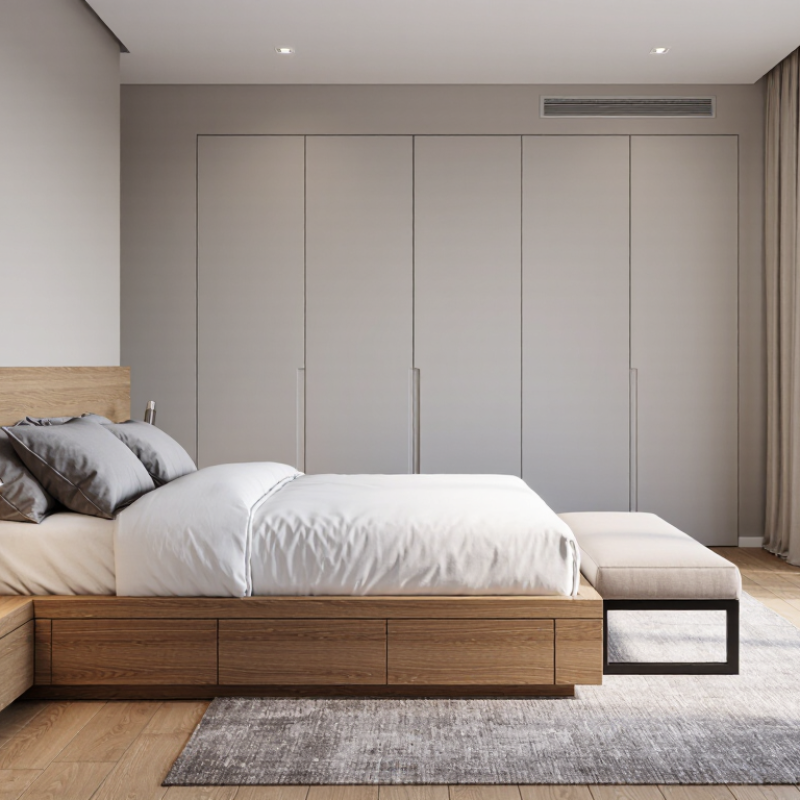
7 Tips for Buying the Best Platform Bed

Measure Your Room Against Standard Sizes: Queen 60 × 80 in; King 76 × 80 in

7 Tips for Buying the Best Platform Bed

Room measurements should guide your platform-bed choice, not showroom impressions. A queen mattress measures 60 × 80 inches, while a king measures 76 × 80 inches, according to Sleep Foundation’s mattress-size data. Add at least 24 inches for walking space on each accessible side. A queen therefore needs about 108 inches of practical width. A king may need 124 inches. Measure wall-to-wall, including baseboards. I once ignored a radiator’s projection and regretted it.

Check seven details before ordering.

  1. One, mark the mattress footprint with painter’s tape.
  2. Two, measure doorways and stair turns.
  3. Three, confirm the platform’s outside dimensions.
  4. Four, check whether drawers need full opening space.
  5. Five, leave clearance for curtains and heating vents.
  6. Six, compare the bed height with your nightstand.
  7. Seven, verify the mattress support requirements. Some foam mattresses need closely spaced slats, not wide gaps.

The National Sleep Foundation’s bedroom guidance emphasizes a quiet, uncluttered sleep environment, but circulation is often overlooked. The U.S. Consumer Product Safety Commission also advises checking bed stability and securing components during assembly. A low platform can make a small room feel larger, yet it may reduce under-bed storage. That trade-off matters. Recheck your measurements twice. Rooms are rarely perfectly square, and my own tape measure once showed a four-inch difference between opposite walls.


Match the Platform Frame to the Mattress’s Exact Dimensions and Type

7 Tips for Buying the Best Platform Bed

Match the Platform Frame to the Mattress’s Exact Dimensions and Type

A platform bed should fit your mattress precisely, not approximately. Measure the mattress itself, including its length, width, and corner shape. Do not rely only on the printed size.

Measure twice. Small gaps matter.

A frame that is too narrow can compress the edges and damage the mattress cover. A frame that is too wide may let the mattress slide during sleep. I once measured only the room, not the mattress, and overlooked a two-centimeter mismatch. That small error created visible movement and uneven support. Check the frame’s interior dimensions before ordering. Compare them with the mattress manufacturer’s specifications when available.

The mattress type also affects the frame choice. Memory foam and latex models usually need closely spaced slats for stable support. Innerspring mattresses may require stronger center reinforcement, especially on larger sizes. Hybrid mattresses can be heavier than they appear, so confirm the frame’s weight capacity. Slats should remain flat and secure, without sharp edges. Do not guess.

Consider ventilation, too. A solid platform can reduce airflow beneath some foam mattresses. A slatted base may help moisture escape, but excessive spacing can cause sagging. Follow the mattress warranty guidelines, even when the frame looks sturdy. Specifications can feel tedious, yet they prevent expensive mistakes. My own choice was once guided by appearance alone, and the attractive frame needed extra support later.

7 Tips for Buying the Best Platform Bed - Match the Platform Frame to the Mattress’s Exact Dimensions and Type

Tip Key Dimension or Feature Reliable Specification What to Check Before Buying
1 Confirm the mattress size Common U.S. mattress dimensions:
Twin: 38 × 75 in
Twin XL: 38 × 80 in
Full: 54 × 75 in
Queen: 60 × 80 in
King: 76 × 80 in
California King: 72 × 84 in
Measure the actual mattress length and width, rather than relying only on the label. Mattress dimensions can vary slightly by construction and manufacturer.
2 Match the interior frame opening Target an inside opening approximately 0.5–1 in larger than the mattress in both length and width, unless the frame instructions specify a different fit. Avoid an opening that is too tight, which can compress the mattress, and avoid excessive clearance, which can allow the mattress to shift or create an uncomfortable gap.
3 Match the frame to the mattress type Foam, latex, and hybrid mattresses generally require firm, continuous support or closely spaced slats. Innerspring mattresses should be used on a platform rated for their weight and support requirements. Check the mattress care instructions for approved foundations, required support surfaces, and any restrictions related to slats or flexible bases.
4 Check slat spacing A maximum gap of 3 in between slats is a conservative choice for many foam and latex mattresses. Some mattresses require narrower spacing. Measure the clear gap between every slat. Wider gaps may reduce support, cause sagging, or affect mattress warranty coverage.
5 Verify center support Queen, king, and California king frames commonly need a center rail with legs that contact the floor. Larger mattresses place greater demands on the middle of the frame. Confirm that the center support runs from head to foot and that all support legs sit firmly on the floor without rocking.
6 Calculate the finished bed height Finished sleeping height equals the platform height plus the mattress thickness. For example, a 14 in platform combined with a 10 in mattress creates an approximately 24 in sleeping surface. Include the thickness of any topper, protector, or bedding layer. Make sure the final height is comfortable for sitting down and standing up.
7 Confirm the weight capacity The rated capacity should cover the combined weight of the mattress, sleepers, bedding, and any regular load placed on the bed. Compare the manufacturer’s stated capacity with the expected total load. For two sleepers, calculate both people together rather than checking the capacity per person.
Measurement note: Dimensions are listed in inches and represent common U.S. mattress standards. Always give priority to the mattress and platform manufacturer’s published support, clearance, and warranty requirements.

Check Slat Spacing Against the Mattress Manufacturer’s Support Requirements

Check slat spacing before choosing a platform bed. Mattress makers set support rules for each construction, and those instructions matter more than a generic online rule. Sleep Foundation’s bed-frame guidance cites 2.75 inches as a common maximum gap, but some mattresses require closer spacing.

Measure between the slats, not across them. Small gaps matter. A wide opening can let foam flex between supports, creating uneven pressure and potentially affecting warranty coverage. Check the maker’s manual or warranty terms for the exact limit.

ASTM International’s F1566 standard provides test methods for evaluating mattress and foundation performance; it does not replace a mattress maker’s compatibility instructions. Count the slats, then measure several gaps, including near the center, where support can vary. Also check whether the frame requires a center rail or extra legs for your bed size. I’d still measure twice; product listings can be vague. If the stated spacing is unclear, ask the seller or manufacturer to confirm it in writing before purchase. A tape measure and a few minutes of checking can prevent a costly mismatch.

Compare the Bed’s Weight Rating With the Combined Load of Sleepers and Mattress

A platform bed’s weight rating is easy to overlook when comparing styles. Check whether the stated limit covers the whole setup or only the sleepers. Add the mattress weight to the combined weight of everyone using the bed, including a child or pet who regularly climbs aboard. A heavy foam or hybrid mattress can add more than expected. Read the product details carefully; the wording is not always clear.

Tip: Compare totals, not guesses. If two sleepers weigh 150 and 190 pounds, and the mattress weighs 110 pounds, the combined load is 450 pounds. Choose a frame rated above that figure, leaving a sensible buffer for movement and uneven loading. Ask the seller or manufacturer what the rating includes if the listing does not say. Small detail, big difference.

Also inspect the support system. A frame’s rating may depend on center legs, closely spaced slats, or a particular assembly method. Confirm those parts are included and installed as directed. Do not assume a sturdy-looking frame can carry more than its published limit. I might be tempted to focus on the headboard first, but the support details deserve a second look. A little awkward to check, perhaps, yet worth doing before delivery.

7 Tips for Buying the Best Platform Bed

Compare the Bed’s Weight Rating With the Combined Load of Sleepers and Mattress

These illustrative examples add the two sleepers’ weights to the mattress weight. In Scenario 2, the combined load is 10 lb above the assumed bed rating. Choose a bed with a rating that comfortably exceeds your total load, and check the manufacturer’s guidance on what the rating includes.

Example calculations: 160 + 160 + 100 = 420 lb; 180 + 180 + 100 = 460 lb; 200 + 200 + 120 = 520 lb; 220 + 220 + 120 = 560 lb. Ratings are illustrative, not product specifications.

Check EPA TSCA Title VI Limits: MDF 0.11 ppm; Particleboard 0.09 ppm

When comparing platform beds, check what the frame panels are made from. MDF and particleboard are common in budget-friendly designs. Under EPA TSCA Title VI, the formaldehyde emission limit is 0.11 ppm for MDF and 0.09 ppm for particleboard. These are panel emission limits, not readings of the air in your bedroom. A lower number does not, by itself, tell you how every finished bed will perform.

Tip: Look for a TSCA Title VI compliance label on the product or packaging. Ask the seller which panels the label covers, especially if the bed combines solid wood, MDF, and particleboard. Clear documentation is more useful than a vague “low-emission” claim. Check assembly instructions, too; cutting or drilling panels can expose unfinished edges.

Also inspect the bed in person, if possible. Notice any strong, persistent odor, but do not treat smell as a formal test. Good ventilation after unpacking is sensible. I still find material descriptions easy to overlook. A detailed spec sheet helps, though it may not answer every question. If the seller cannot identify the panel material or explain its compliance information, compare another option.